


FIELD NOTES
Published July 2026
Donnerskirchen, Austria
Every year it starts again.
The first wasp lands on a piece of cake, circles a glass of lemonade or flies over the garden table. For many people, the verdict is immediate:
The nest has to go.
Yet behind this idea lies a misunderstanding.
The wasps that visit our food in late summer almost always belong to just two species. Most other native wasps show little interest in our coffee table. They hunt flies, mosquitoes, caterpillars and many other insects – often unnoticed and without ever coming into conflict with us.
Interestingly, it is precisely these peaceful species that often build their nests in plain sight: under eaves, in shrubs or on garden sheds.
The truly intrusive species, on the other hand, usually live out of sight – in roller shutter boxes, lofts, wall cavities or underground.
So a visible nest by no means indicates that it houses the wasps that bother us at a barbecue or over coffee.
Wasps have a bad reputation mainly because we almost only notice them when they compete with us for food.
Most of their lives, however, look very different.
They hunt other insects.
Not for themselves, but for their larvae. Over the course of a summer, a wasp colony carries enormous quantities of flies, mosquitoes, caterpillars and other insects into its nest. In doing so, wasps perform a task that is often overlooked in our gardens and cultivated landscapes: they regulate insect populations naturally.
Although they are our largest native wasps, they are considered remarkably peaceful. Their size is impressive, but their behaviour is usually strikingly calm. Anyone who keeps their distance from the nest will often find that hornets pay little attention to people.
They have more important things to do.
That is why we do not destroy wasp nests hastily.
Not every nest needs to be removed.
Not every nest poses a danger.
And not every wasp is the one that turns up at our coffee table.
If a nest really is in a problematic place, it can now be relocated professionally. Destroying it should always remain the last resort.
Because every wasp colony that survives is part of a functioning ecosystem.
And perhaps nature conservation sometimes begins right there:
Not with intervention.
But with better understanding.
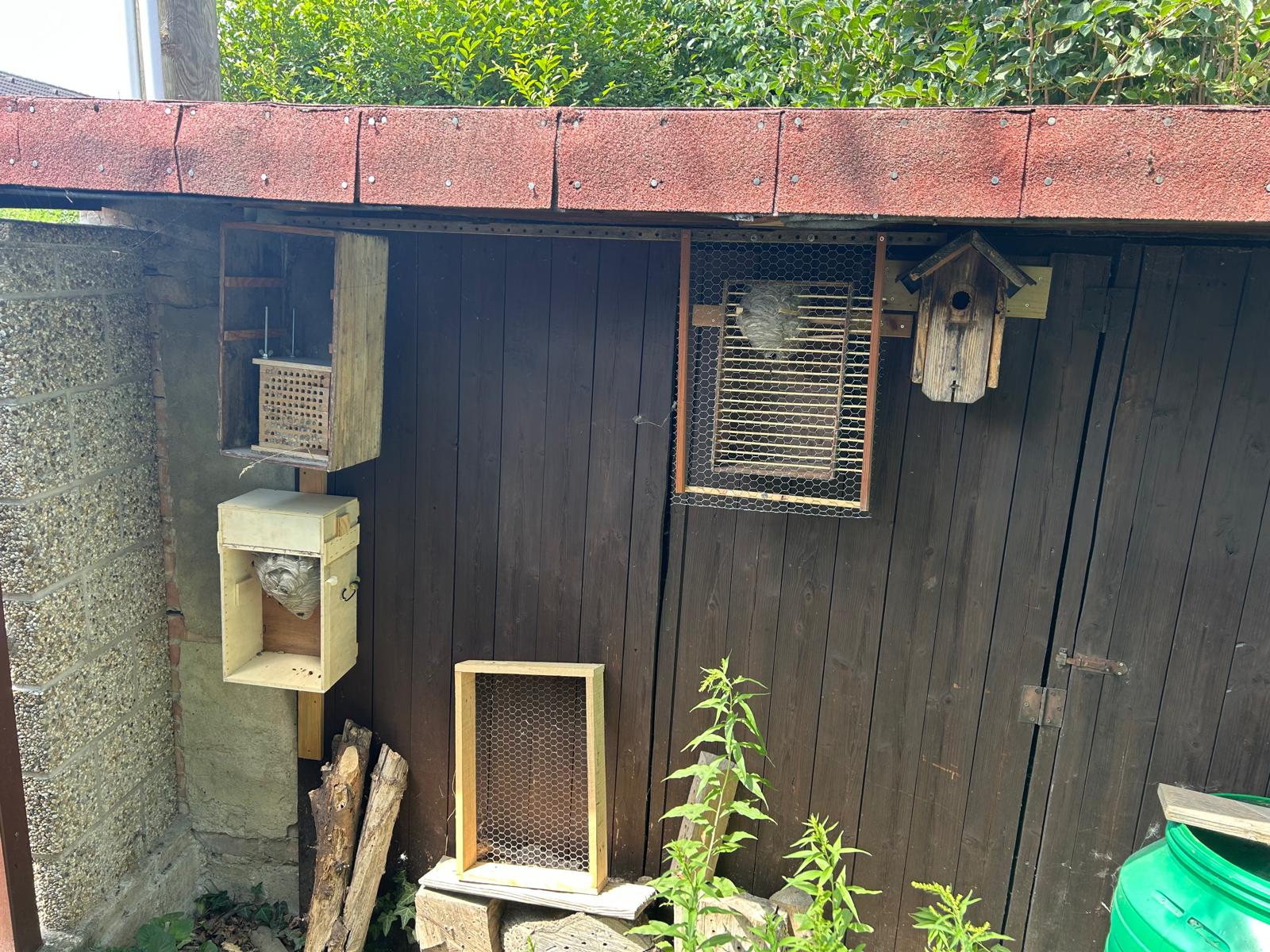
Not every encounter with nature calls for a solution.
Some only call for understanding.
A wasp nest does not automatically have to be removed.
A hornet’s nest is not a problem, but part of a functioning ecosystem.
We believe that good beekeeping does not end where the beehive ends.
It begins with respect for all the species that keep our landscape in balance.
To provide the best experiences, we use technologies like cookies to store and/or access device information. Consenting to these technologies will allow us to process data such as browsing behavior or unique IDs on this site. Not consenting or withdrawing consent, may adversely affect certain features and functions.
Um die besten Erlebnisse zu bieten, verwenden wir Technologien wie Cookies, um Geräteinformationen zu speichern und/oder darauf zuzugreifen. Wenn Sie diesen Technologien zustimmen, können wir Daten wie das Surfverhalten oder eindeutige IDs auf dieser Website verarbeiten. Wenn Sie Ihre Zustimmung nicht erteilen oder widerrufen, können bestimmte Merkmale und Funktionen beeinträchtigt werden.