


FIELD NOTES
Published July 2026
Donnerskirchen, Austria
Few things in beekeeping attract more attention than a swarm.
For many beekeepers, it is a loss.
For the bees, it is reproduction.
That difference is worth knowing.
In modern beekeeping, a great deal of effort goes into preventing swarms.
Swarm cells are broken down. Colonies are split. Space is added. Queens are replaced.
There are good reasons for this.
A swarm takes a large share of the foragers with it. The honey yield drops. Sometimes the swarm is lost.
From a beekeeper’s point of view, that is understandable.
From the bees’ point of view, however, the world looks different.
It is its natural way of reproducing.
For millions of years, new colonies have come into being when an old queen leaves the hive with part of the colony and founds a new home somewhere else.
Not because something went wrong.
But because the colony has grown strong enough.
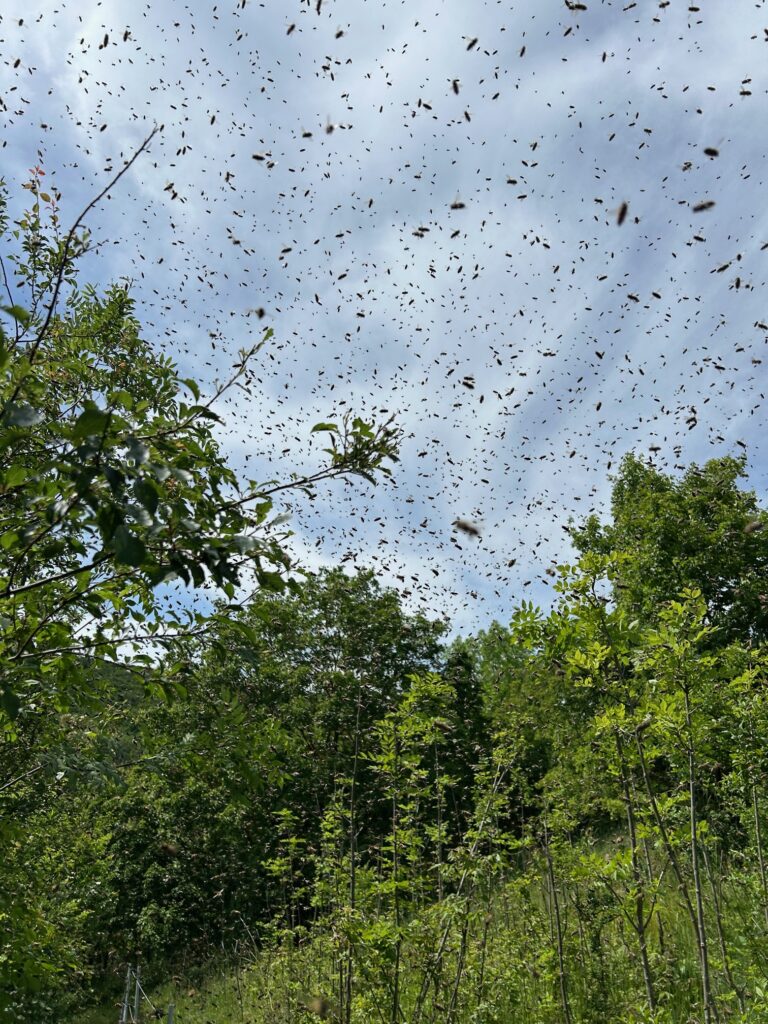
Recent scientific studies of wild-living honey bees show how important this process really is.
Wild honey bee colonies often die within a few years.
Many do not survive the winter.
Their population only persists because new swarms emerge every year and settle in new nest sites.
Without swarms, there would hardly be any wild-living honey bee colonies in the long run.
The swarm is therefore not just a behaviour.
It is part of their survival.
This does not mean that every beekeeper should let their bees swarm uncontrolled.
Beekeeping means responsibility.
Anyone who keeps bees is responsible for their colonies, for their neighbours and for animal health.
But there is a big difference between an uncontrolled swarm and consistently suppressing every natural swarming instinct.
We try to understand it.
That is why we often use swarm cells to make splits.
A split is not a swarm.
But it follows the same biological principle.
A new colony grows out of a strong one.
Without artificial queen rearing.
Without completely suppressing the natural reproductive instinct.
Thomas Seeley does not describe the honey bee as an animal that wants to produce as much honey as possible.
He describes it as an organism whose most important task is to reproduce successfully and to survive in the long term.
Anyone who wants to understand the honey bee should therefore not only look at the honey yield.
But also at its biology.
Perhaps that is the most important difference.
We do not see a swarm first and foremost as lost honey.
But as a reminder of how honey bees have lived for millions of years.
Seeley, T. D. The Lives of Bees: The Untold Story of the Honey Bee in the Wild. Princeton University Press, 2019.
Kohl, P. L., Rutschmann, B., Steffan-Dewenter, I. et al. Population biology of feral honey bees. Annual Review of Entomology, 2022.
Summary of current reporting on new findings about wild-living honey bees in Germany, together with primary scientific literature on the population behaviour of wild honey bees.
To provide the best experiences, we use technologies like cookies to store and/or access device information. Consenting to these technologies will allow us to process data such as browsing behavior or unique IDs on this site. Not consenting or withdrawing consent, may adversely affect certain features and functions.
Um die besten Erlebnisse zu bieten, verwenden wir Technologien wie Cookies, um Geräteinformationen zu speichern und/oder darauf zuzugreifen. Wenn Sie diesen Technologien zustimmen, können wir Daten wie das Surfverhalten oder eindeutige IDs auf dieser Website verarbeiten. Wenn Sie Ihre Zustimmung nicht erteilen oder widerrufen, können bestimmte Merkmale und Funktionen beeinträchtigt werden.