


FIELD NOTES
Published August 2026
Donnerskirchen, Austria
How honey bees learn a landscape and find their way home again
Every foraging flight confronts a bee with two tasks.
It has to find a source of food.
And it has to get back home.
The second part seems obvious. We see bees rise from the entrance and return later. In between, however, they may cross large parts of a landscape.
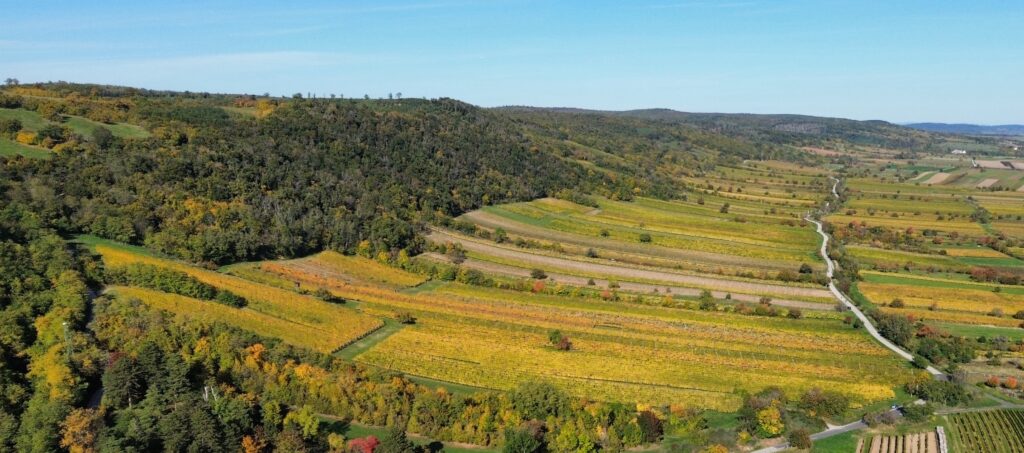
Over meadows and vineyards.
Along woodland edges, paths and rows of trees.
Past buildings, field boundaries and streams.
Soon the hive is no longer in sight.
And yet the forager returns.
Not with the help of a single sense.
But with a sophisticated system.
A young worker bee does not start out with long foraging flights.
Before it regularly brings in nectar or pollen, it makes orientation flights. At first it stays close to the hive. Later it explores larger areas of the surroundings.
In doing so, it looks at the site from different directions and distances. It gets to know not only the entrance or the hive, but also the landscape around the colony.
Experiments with marked bees show that even single orientation flights can make a measurable difference: bees return more quickly and more directly from areas they have already explored than from areas they have not yet got to know. Further studies show that the spatial extent of orientation flights changes as the bees gain flight experience.
The first step in navigation is therefore not an innate, ready-made map.
It really is learning.
During an orientation flight, the bee first moves back and forth in front of the entrance.
Again and again it turns its body towards the hive, changing its distance, height and line of sight as it does so.
This allows it to perceive the same surroundings from different perspectives.
A tree looks different close up than from further away.
A building changes its visible shape when approached from another side.
Depending on the direction of flight, a row of trees appears as a long line or as a narrow point.
The bee therefore has to do more than recognise individual objects. It has to learn how the appearance of its surroundings changes during flight.
The apiary thus becomes more than just a visible object.
It takes its place within a familiar landscape.
When a bee leaves the hive, it can continuously process information about its own movements.
It flies a certain distance in a certain direction. Then it changes course, flies on and changes course again.
From these legs it can work out a direct route back to its starting point. This principle is known as path integration.
Put simply, during its flight the bee keeps track of the direction and distance it has travelled away from the hive. This produces a so-called home vector: a direction and distance back to the colony.
Radar measurements have made such goal-directed flight sections visible. Bees can hold a largely straight course towards a known destination over longer distances, compensating for crosswinds as they go.
To do this, the bee does not have to fly back along every single curve of its outward flight.
It can calculate a more direct route.
The inner way home works particularly well as long as the bee really starts from where it thinks it is.
Researchers make use of exactly this.
A foraging bee is caught at a familiar feeding site, carried to another location in a dark container and released there.
The bee does not know that it has been moved.
That is why it often begins with the flight that would have taken it home from the original feeding site. From its new starting point, however, this vector does not lead to the hive.
Once it has reached the expected position and does not find the hive there, its behaviour changes.
It starts to search.
In familiar terrain, direct flights home can then follow. Such experiments show that bees combine the calculated home vector with information from the actual landscape.
So the inner odometer alone is not always enough.
The bee also has to recognise where it actually is.
An important part of navigation is the sun compass.
The position of the sun provides large-scale directional information. But the sun moves across the sky during the day. The same position of the sun means something different in the morning than in the afternoon.
Honey bees therefore link the position of the sun with an internal clock.
They take into account the time of day at which they perceive a particular position of the sun. Experiments in which the day-night rhythm of bees was artificially shifted show that a shifted internal clock also changes the expected compass direction.
So the bee does not just read the sky.
It combines sky and time.
Even a cloudy sky is not necessarily without direction for a bee.
Sunlight creates a pattern of polarised light in the atmosphere. To the human eye, this pattern remains invisible without technical aids. Bees, however, can perceive the direction in which light vibrates and derive compass information from it.
This part of their perception takes place in a specialised area at the upper edge of their compound eyes and is particularly adapted to ultraviolet light.
When direct information from the sky is missing, familiar landscape structures can serve as an additional aid to orientation. Classic experiments already showed that, under an overcast sky, honey bees can use a familiar line in the terrain as a substitute for compass information.
So the sky is an important compass.
But not the only one.
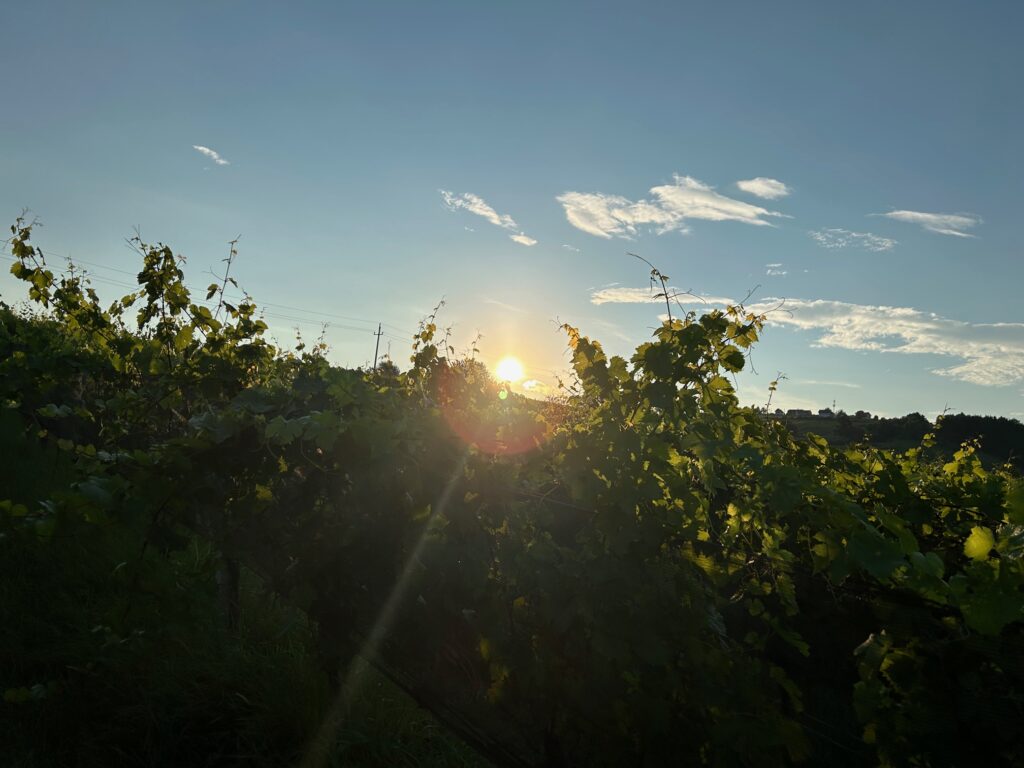
For a bee, they can be lines of orientation.
Studies under natural conditions show that honey bees can learn elongated landscape structures and use them on their flights home. These include, for example:
Woodland edges.
Streams.
Field boundaries.
Paths.
Overgrown ditches.
Rows of trees.
Shape alone is apparently not enough. The orientation of a structure relative to the points of the compass and its place in the rest of the landscape can also play a role.
A familiar line can guide the bee. But it does not work in isolation, like a rail. Its significance depends on which other features are present at the same time and what experience the bee has gathered before.
The bee does not simply remember:
Follow every path.
It learns:
This path lies in this direction, next to these other features, and in this context leads to a familiar destination.
A prominent tree can be helpful.
But a single tree does not explain a whole landscape.
The bee is evidently able to link several visible elements. A woodland edge gains its meaning from its direction. A row of trees from its position relative to a path. A building from its position relative to the apiary.
This creates a spatial context.
Recent experiments show that bees can even transfer memories of elongated landscape structures to similar, unfamiliar structures. Bees that were taken from a familiar environment to a strange place preferred to search along lines whose arrangement resembled features of their usual landscape. The researchers saw this as an indication that not only individual views but also the relationships between landscape features are stored.
The landscape thus becomes more than a collection of visible objects.
It becomes an ordered whole.
Navigation does not always require a complete overview.
A bee can also learn specific views.
It approaches the hive from a particular direction. The visible panorama resembles a stored view. If it deviates from it, the bee changes its direction of flight until the current image matches its memory more closely.
Such memory-based views can be particularly effective close to a destination.
From a great distance, compass direction and home vector help.
In familiar terrain, landscape structures come into play.
In the immediate surroundings, individual views, scents and features of the apiary can determine the last part of the way back.
Navigation is therefore not a single process.
It changes along the route.
This brings us to the most difficult question.
Do honey bees have an inner map?
Some experiments point to a spatial memory organised like a map. After initially heading the wrong way, displaced bees were able to set direct courses to the hive or to a familiar feeding site from different parts of familiar terrain.
The researchers involved concluded that bees can link places and their spatial relationships in such a way that they can choose a familiar destination from an unexpected starting point.
But the term “cognitive map” is scientifically disputed.
Other researchers argue that the same abilities could also be explained by a combination of simpler mechanisms:
stored views,
familiar routes,
compass information,
path integration
and the step-by-step recognition of landscape features.
They do not regard the experiments so far as clear proof of a coherent inner map in the strict sense.
So it is not established that a bee represents the landscape the way we read a map.
What is established is that its spatial memory achieves far more than simply repeating a single learned route.
Perhaps the image of a human map points in the wrong direction.
A bee does not have to carry a scaled-down picture of the landscape in its head.
It needs tools that work together:
a sun compass,
an internal clock,
information about its own movement,
stored views,
familiar landscape structures,
scents
and the ability to compare different clues with one another.
Which tool matters most at any moment depends on the situation.
Is the sun visible?
Is the bee in familiar terrain?
Has it been moved?
Is the destination still far away?
Are there prominent structures?
The honey bee’s sense of direction is therefore not impressive because it follows a single perfect system.
It is impressive because several incomplete systems together make a reliable way home possible.
Navigation is not an infallible ability.
Strong wind can blow a bee off course.
Low cloud can make parts of celestial orientation more difficult.
A monotonous landscape offers fewer striking visual clues than a richly structured environment.
Experience plays a role too. An older forager that has flown over an area many times has different memories from a bee after its first orientation flights.
Nevertheless, combining several sources of information can compensate for many of these uncertainties.
If one clue fails, others remain.
The sun may be hidden while a familiar woodland edge remains visible.
A home vector can be thrown off by displacement, while the recognised landscape makes a correction possible.
A stored view may only become useful near the hive, after the sun compass has set the direction for most of the way.
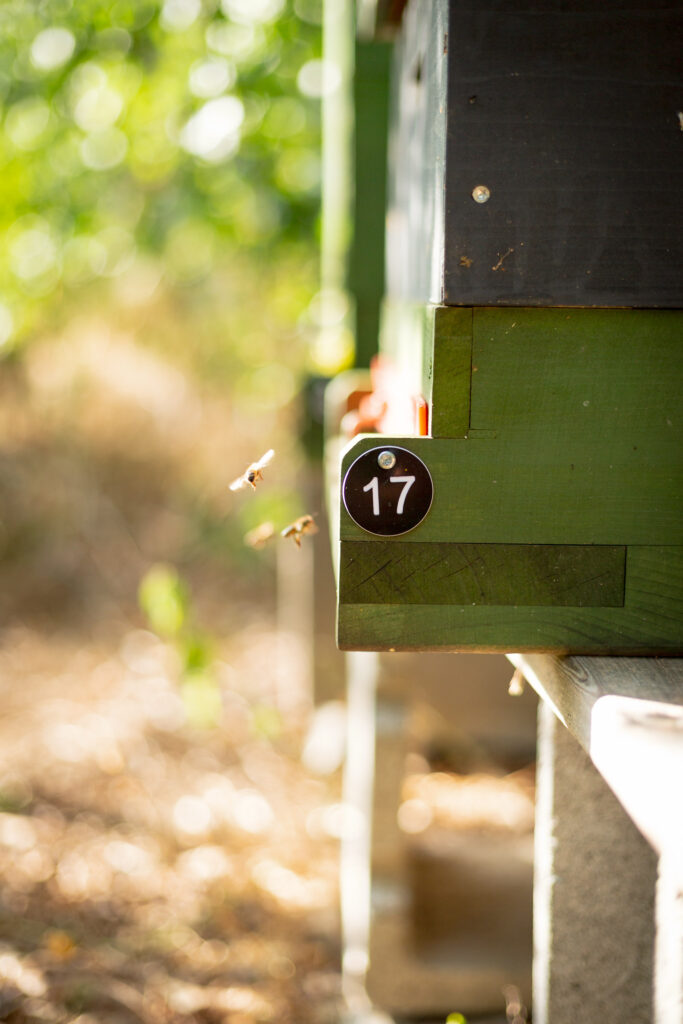
A foraging flight does not end when a flower has been found.
The bee has to bring the nectar home.
It can take up the food outside. But it is transformed and stored inside the colony.
Every drop that reaches the hive therefore depends on a successful return.
The forager has crossed the landscape.
It has processed direction and distance.
It has recognised familiar structures.
It has corrected its course.
And it has found the entrance to its colony again.
None of this remains visible in the honey.
No flight path.
No woodland edge.
No position of the sun.
No stored memory.
And yet without all of this, the honey would not exist.
We do not bring the bees home.
We do not draw routes for them through the landscape.
We do not decide which row of trees they recognise, which woodland edge gives them orientation or which memory they use on their way back.
The bees learn their surroundings themselves.
They fly out.
They lose sight of the hive.
And they find their way back.
We do not make this honey.
We keep what has matured in the colony after countless successful journeys home.
Found by the bees.
Carried home by them, transformed and matured.
Harvested and kept by us.
Robert E. Page: Die Kunst der Bienen. Wie Bienenvölker unsere Welt gestalten. Translated from English by Jens Hagestedt. C.H.Beck, München 2025.
Degen, J. et al.: Honeybees Learn Landscape Features during Exploratory Orientation Flights. Current Biology 26, 2800–2804, 2016.
Capaldi, E. A. et al.: Ontogeny of orientation flight in the honeybee revealed by harmonic radar. Nature 403, 537–540, 2000.
Riley, J. R. et al.: The automatic pilot of honeybees. Proceedings of the Royal Society B 270, 2421–2424, 2003.
Dyer, F. C. and Gould, J. L.: Honey bee orientation: a backup system for cloudy days. Science 214, 1041–1042, 1981.
Menzel, R. et al.: Honey bees navigate according to a map-like spatial memory. Proceedings of the National Academy of Sciences 102, 3040–3045, 2005.
Menzel, R. et al.: Guidance of Navigating Honeybees by Learned Elongated Ground Structures. Frontiers in Behavioral Neuroscience 12, 322, 2019.
Cheeseman, J. F. et al.: Way-finding in displaced clock-shifted bees proves bees use a cognitive map. Proceedings of the National Academy of Sciences 111, 8949–8954, 2014.
To provide the best experiences, we use technologies like cookies to store and/or access device information. Consenting to these technologies will allow us to process data such as browsing behavior or unique IDs on this site. Not consenting or withdrawing consent, may adversely affect certain features and functions.
Um die besten Erlebnisse zu bieten, verwenden wir Technologien wie Cookies, um Geräteinformationen zu speichern und/oder darauf zuzugreifen. Wenn Sie diesen Technologien zustimmen, können wir Daten wie das Surfverhalten oder eindeutige IDs auf dieser Website verarbeiten. Wenn Sie Ihre Zustimmung nicht erteilen oder widerrufen, können bestimmte Merkmale und Funktionen beeinträchtigt werden.