


FIELD NOTES
Published Juni 2026
Donnerskirchen, Austria
Full protective gear is not a sign of fear. For us, it is a tool for greater calm when working with a colony.
Wearing a beekeeping suit is not a sign of fear. For us, it is a tool that allows for greater calm when working with a colony.
An article about why good beekeeping does not begin with how much discomfort a person can endure, but with how little disturbance they cause.
There are certain images we often see in beekeeping.
A beekeeper without a veil. Without gloves. Standing directly beside an open colony. Calm, seemingly unaffected, almost demonstratively so.
These images are powerful.
But they do not always tell the whole story.
For us, the question is not how little protection a beekeeper needs.
The question is how calmly a colony can continue its work.
Whenever I work with the bees, I wear full protective clothing: long trousers, a beekeeping jacket with a veil, and leather gloves. Always.
Not because I am afraid of them.
But because it allows me to work more calmly.
Good protective clothing changes the way you move around a colony. You become slower. More deliberate. More composed. You do not suddenly pull back when a bee takes flight. You do not swat at the air. You do not interrupt your work because a sting feels imminent.
That does not only help the beekeeper.
It also helps the bees.
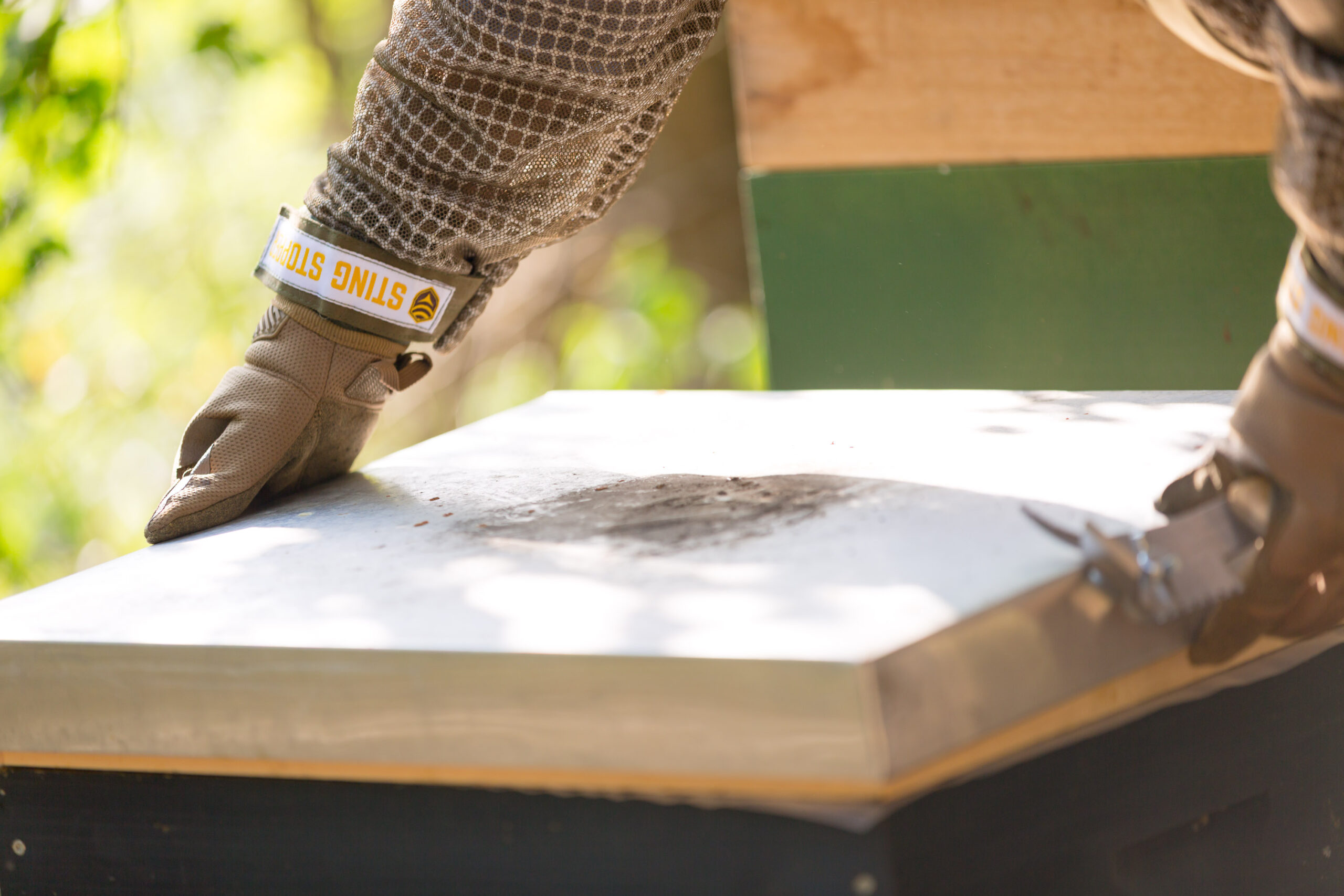
Of course, gloves change the way things feel in your hands.
You do not feel the wood, the wax, and the bees quite as directly as you would with bare fingers. But with practice, this does not become an obstacle.
Gloves may reduce some of the sensitivity in your hands.
But they do not remove the care from your work.
With experience, the work remains gentle, calm, and precise. Frames can be moved carefully. Bees do not need to be unnecessarily pressed or crushed. The work inside the colony remains controlled.
For me, protection is therefore not a loss of closeness.
It is what allows me to remain calm.
A bee colony is not an aggressive system. It is a sensitive one.
Bees respond to vibrations, rapid movements, pressure, scents, breath, weather, available forage, and the internal condition of the colony. When work at the apiary becomes hurried, the colony’s response often becomes more unsettled as well.
Good beekeeping therefore begins before a frame is ever lifted.
It begins with the attitude you bring to the colony.
Slowly.
Attentively.
Without unnecessary pressure.
Some colonies are exceptionally calm.
Others are more alert.
And some are more defensive.
For me, that is part of the reality of beekeeping. A bee colony is not a product that behaves the same way every time. It is a living organism with its own dynamics, its own queen, its own history, and its own response to weather, forage, and intervention.
I do not select my bees solely according to how convenient they are for me to handle.
Gentleness matters. Of course it does. A colony must be manageable in a responsible way. But I do not regard defensiveness only as a fault. It can also be an expression of vitality, alertness, and a willingness to defend the colony.
A bee colony protects its stores, its brood, and its queen.
That is not irrational.
It is part of its nature.
In beekeeping, colonies are often selected for particular characteristics.
Gentleness. Honey production. Low swarming tendency. Steadiness on the comb. Behaviour during inspections.
This can be useful. But every act of selection is also an intervention. It means that certain characteristics are encouraged while others are deliberately reduced.
For me, the question is therefore always the same:
Does this decision serve the colony? Or does it primarily serve human convenience?
Replacing a queen is possible in beekeeping. Sometimes it is necessary. But it remains a significant intervention in the life of a colony.
That is why I do not treat it as routine.
I do not want to change every colony immediately simply because it is not perfectly gentle.
First, I want to understand why it is reacting as it does.
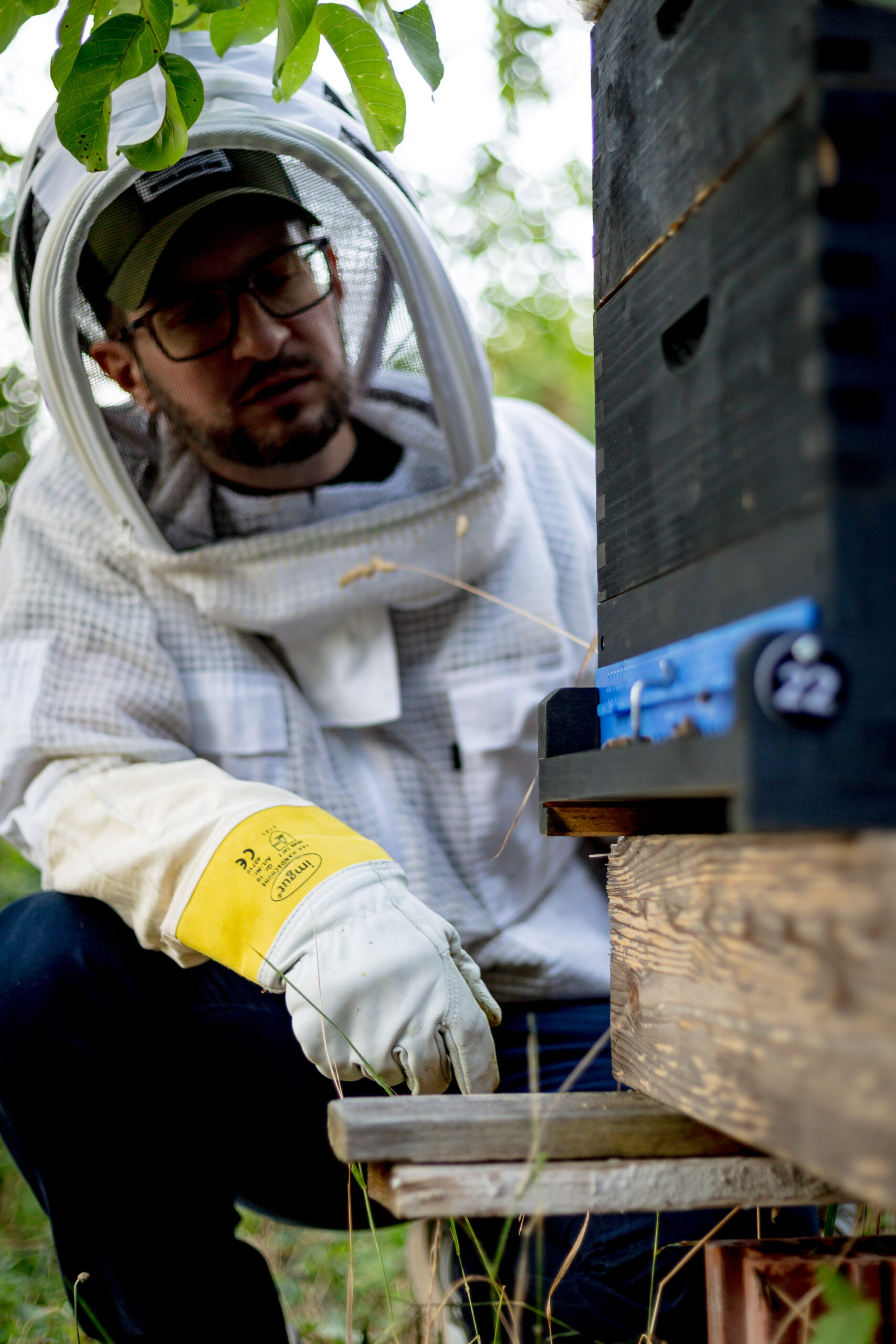
A sting is not only unpleasant for a person.
For the bee, it is also a loss.
When a honey bee stings human skin and its barbed stinger remains behind, the bee will generally die as a result. Every avoided sting is therefore better for both sides.
Full protection allows me to remain calm even when a colony is more nervous or defensive than usual. I do not have to react. I do not have to prove anything. I do not have to work faster.
I can simply continue working calmly.
And that calm often makes all the difference.
Beekeeping always involves intervention.
A hive is opened. Frames are moved. The colony is temporarily disturbed.
It is therefore our responsibility to make that intervention as gentle as possible.
No longer than necessary.
No more hurried than necessary.
No harsher than necessary.
A calm beekeeper is not the result of chance.
Calm is a decision.
And sometimes that decision begins with something very simple: good equipment that provides a sense of security.
At The Beekeeper – ARTISAN HONEY, we do not understand beekeeping as control over bees.
We understand it as stewardship.
We observe. We intervene when necessary. We leave them undisturbed whenever possible. We try to see each colony as a living organism, not as a means of production.
That also means not making our own role greater than it is.
The bees make the honey.
The beekeeper merely creates the conditions in which they can work as well as possible.
For me, full protective clothing is therefore not incompatible with closeness to the bees.
It is a tool for greater calm.
It protects me.
It protects the work.
And it helps make every moment beside an open colony as respectful as possible.
Not braver.
Not more spectacular.
Not for the sake of an image.
Simply calmer.
Because good beekeeping does not begin with how much discomfort a person can endure.
It begins with how little disturbance they cause.
To provide the best experiences, we use technologies like cookies to store and/or access device information. Consenting to these technologies will allow us to process data such as browsing behavior or unique IDs on this site. Not consenting or withdrawing consent, may adversely affect certain features and functions.
Um die besten Erlebnisse zu bieten, verwenden wir Technologien wie Cookies, um Geräteinformationen zu speichern und/oder darauf zuzugreifen. Wenn Sie diesen Technologien zustimmen, können wir Daten wie das Surfverhalten oder eindeutige IDs auf dieser Website verarbeiten. Wenn Sie Ihre Zustimmung nicht erteilen oder widerrufen, können bestimmte Merkmale und Funktionen beeinträchtigt werden.